The Southern African Development Community (SADC) Humanitarian and Emergency Operations Centre (SHOC) has reaffirmed its commitment to strengthening regional and international cooperation in Disaster Risk Management through its participation in the Association of Southeastern Asian Nations (ASEAN) Strategic Policy Dialogue on Disaster Management (SPDDM) 2026 from 19 to 20 August 2026. The engagement provided an important platform for strategic dialogue, knowledge exchange, and partnership-building regional intergovernmental humanitarian institutions from Africa, Asia, Europe and the Caribbean.
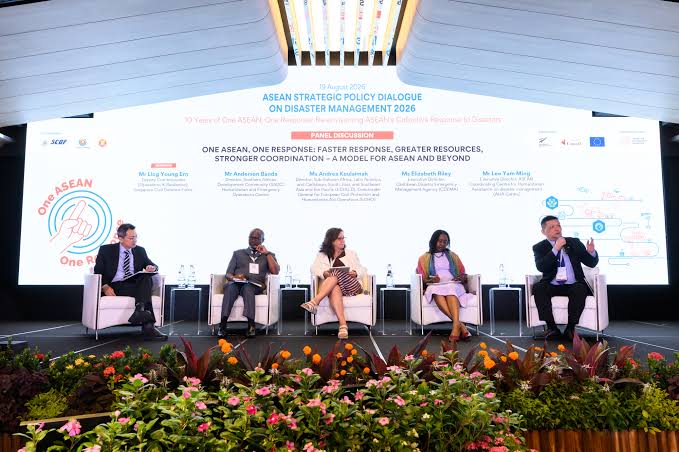
The Director of SHOC, Mr. Anderson Banda, participated in the high-level dialogue, engaging with regional Disaster Management leaders, Development Partners, and Humanitarian organisations to share experiences on strengthening Multi-Hazard Early Warning systems, disaster preparedness, Anticipatory Action, and coordinated Emergency Response. The participation forms part of SHOC's broader strategy to establish strategic partnerships that enhance regional resilience and operational readiness across the SADC region.
Held under the auspices of ASEAN's regional disaster management cooperation framework, the Strategic Policy Dialogue brought together senior policymakers and practitioners to discuss emerging disaster risks, climate-induced hazards, innovations in humanitarian response, and opportunities for cross-regional collaboration. The discussions highlighted the growing importance of integrated early warning systems, regional coordination mechanisms, risk-informed decision-making, and the application of technology in disaster preparedness and response.
On the margins of the Dialogue, Mr. Banda held bilateral discussions with the ASEAN Coordinating Centre for Humanitarian Assistance on Disaster Management (AHA Centre) to explore opportunities for institutional collaboration and knowledge exchange between SHOC and the AHA Centre. The discussions focused on sharing operational experiences in emergency coordination, strengthening humanitarian information management, and promoting collaboration on capacity development. A follow-up visit by a SHOC delegation to the AHA Centre is expected as both institutions seek to formalise areas of cooperation.
The SHOC Director also met with representatives of the Directorate-General for European Civil Protection and Humanitarian Aid Operations (DG ECHO) to discuss ongoing collaboration under existing programmes and identify opportunities to further strengthen support for disaster preparedness, early warning, anticipatory action, and emergency response within the SADC region.
In addition, Mr. Banda also held discussions with the Caribbean Disaster Emergency Management Agency (CDEMA) aimed at promoting South-South cooperation and exchanging best practices on regional disaster coordination. During the meeting, CDEMA extended an invitation for a SHOC delegation to undertake a technical visit to its headquarters to further strengthen institutional cooperation and facilitate peer learning between the two regional mechanisms.
Speaking following the Dialogue, Mr. Banda noted that engagement with global and regional disaster management institutions is essential for strengthening SHOC's mandate as SADC's regional humanitarian coordination mechanism.
"Disasters are increasingly complex, interconnected, and transboundary in nature. Strengthening partnerships with leading regional disaster management institutions such as ASEAN's AHA Centre provides valuable opportunities for mutual learning, innovation, and the exchange of operational best practices. These partnerships will contribute significantly to enhancing disaster preparedness, early warning, and coordinated emergency response across the SADC region."
The Director further noted that the engagement reflects SHOC's commitment to building a stronger global network of partners capable of supporting Member States before, during, and after disasters through improved coordination, information sharing, and technical cooperation.
The participation in SPDDM 2026 resulted in the establishment of new strategic networks and strengthened SHOC's engagement with regional and international disaster management partners. These engagements are expected to support future collaboration in areas including multi-hazard early warning systems, humanitarian information management, simulation exercises, capacity development, emergency operations coordination, and anticipatory action.
As SADC continues to strengthen regional disaster preparedness and resilience, SHOC remains committed to fostering strategic partnerships that enhance operational excellence, facilitate knowledge exchange, and improve coordinated humanitarian action for the benefit of all SADC Member States.


